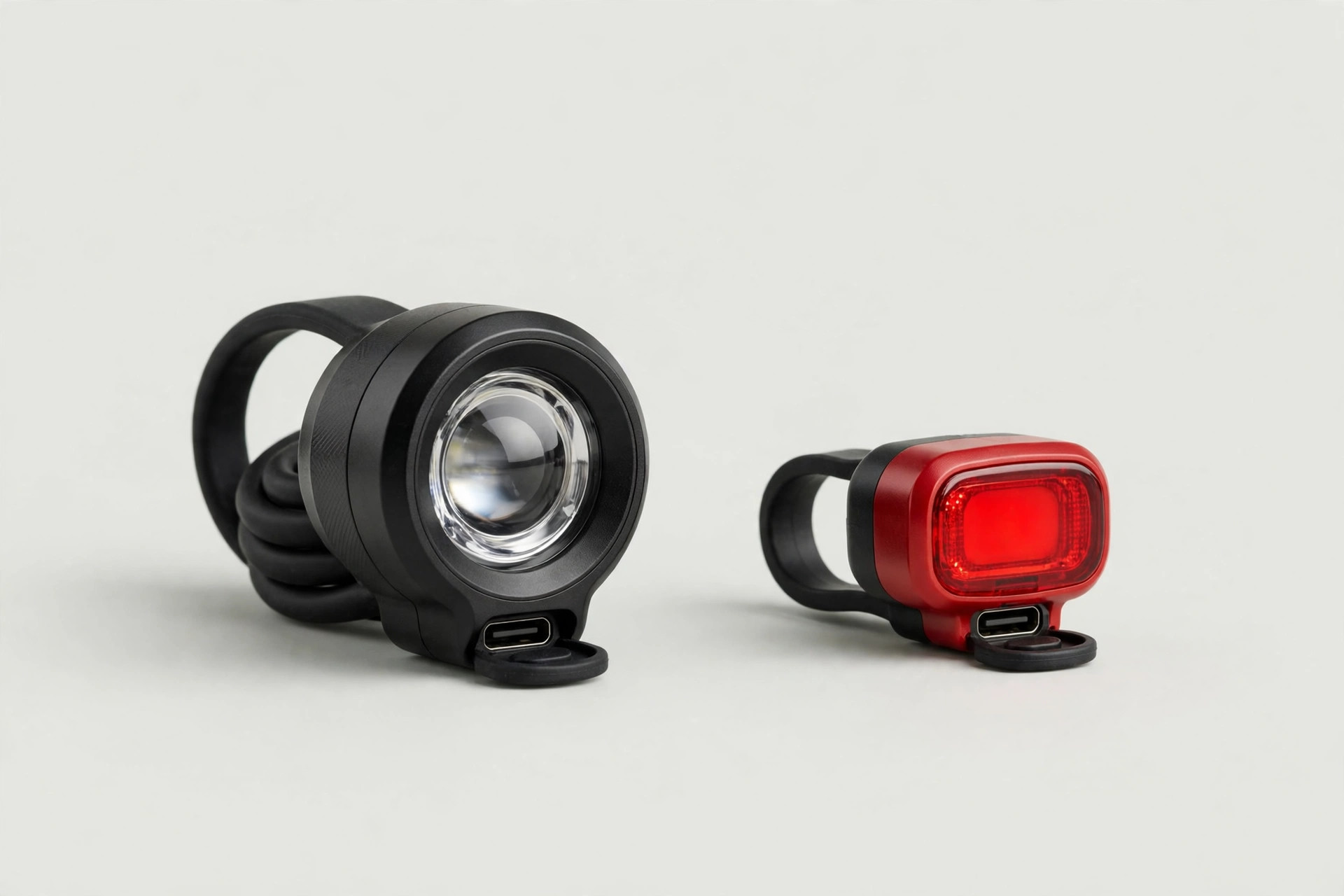
November evenings end the daylight commute: the ride home is now a ride in the dark. An ebike makes that ride faster, which makes lights more important, not less — at 20 mph you cover ground a pedal bike never did, and drivers need to see you sooner. The right set does two jobs at once: a front light that shows you the road, and a rear light that shows you to traffic. Every pick below is USB-rechargeable (no disposable batteries), because a light you have to feed batteries is a light that ends up dead in a drawer.
Volt Dialed is reader-supported. When you buy through links on our site, we may earn an affiliate commission.
What matters in an ebike light (in order)
- Beam, not just lumens: a big lumen number in a round flashlight beam blinds oncoming traffic and wastes light on treetops. A shaped beam with a cutoff — bright on the road, dim above it — is worth more than raw output.
- Runtime at a usable mode: headline runtimes are quoted at the dimmest flash. Check the runtime at the steady mode you will actually ride in — you want at least your full commute, twice over, before a recharge.
- USB-C charging: USB-C charges faster and uses the cable you already carry. Micro-USB sets still exist at the budget end; they work, but they are slower and one more cable to keep.
- Mount that fits your bars: most mounts fit standard 22–35mm bars, but oversized ebike bars, displays, and grips crowd the clamp area. Tool-free rubber-strap mounts move between bikes in seconds.
- Rear light included (or bought with it): a front-only light leaves the most dangerous direction — traffic behind you — dark. Buy a set, or pair a front light with a rear light on the same order.
- Weather sealing: look for an IPX4 rating or better. A light that fogs or dies in the first rain is not a commuter light.
Our picks
- Lezyne Mega Drive 1800i — Best overall
- Cygolite Metro Pro 1100 — Best value high-output
- NiteRider Lumina 1200 Boost — Best for dark roads
- Blackburn Dayblazer 1000 set — Best front + rear set
- Ascher USB rechargeable set — Best budget set
| Light | Best for | Key spec | Price |
|---|---|---|---|
| Lezyne Mega Drive 1800i | Serious night commuting | 1800 lumens · USB-C · shaped beam | Check price → |
| Cygolite Metro Pro 1100 | High output per dollar | 1100 lumens · USB-C · daytime flash | Check price → |
| NiteRider Lumina 1200 Boost | Unlit roads and trails | 1200 lumens · Boost mode · USB-C | Check price → |
| Blackburn Dayblazer 1000 set | One-box front + rear | 1000-lumen front · 65-lumen rear · USB-C | Check price → |
| Ascher USB rechargeable set | Budget commuters and second bikes | Front + rear set · USB rechargeable · 4 modes | Check price → |
The five picks
1. Lezyne Mega Drive 1800i — typically ~$110–$130 Best overall
The commuter flagship: 1800 lumens through a shaped lens that puts light on the road instead of into drivers' eyes, USB-C charging, and a solid aluminum body that survives daily bag-and-bar life. The Infinite Light Power Pack compatibility means a spare battery swaps in for very long rides. Best for: riders who commute in the dark most of the year and want one light done right. Watch out: it is bigger and heavier than a be-seen blinky — this is a see-the-road light, sized like one.
Best for: dark year-round commuting — the brightest well-shaped beam here. Not ideal for: minimalists — it is a substantial unit.
- 1800 lumens with a road-shaped beam, not a flashlight cone
- USB-C charging and swappable battery option
- Aluminum body built for daily use
- Premium price for a front-only light — add a rear light
- Larger and heavier than budget lights
Our verdict: The best night-commuting front light in this roundup — bright, shaped, and durable.
2. Cygolite Metro Pro 1100 — typically ~$60–$80 Best value high-output
The value sweet spot: 1100 lumens, USB-C, and a daytime flashing mode that makes you visible in traffic even before sunset — the mode many commuters actually use most. Cygolite's long track record in commuter lights shows in the mount and the mode memory. Best for: riders who want real road illumination without the flagship price. Watch out: the beam is wider and less shaped than the Lezyne's, so aim it slightly down on shared paths.
Best for: high output per dollar, with a genuinely useful daytime flash. Not ideal for: unlit country roads at full ebike speed — step up to 1800 lumens there.
- 1100 lumens at a mid-range price
- Daytime flash mode for lit-street visibility
- USB-C and a proven, tool-free mount
- Beam less shaped than the Lezyne — aim it down
- Front-only — pair it with a rear light
Our verdict: The most light per dollar here — the pick for most commuters.
3. NiteRider Lumina 1200 Boost — typically ~$90–$110 Best for dark roads
The dark-road specialist: 1200 lumens with a Boost mode that throws a long, even beam down unlit roads and trails, plus a lock mode so it cannot switch on in your bag. NiteRider's handlebar mount is one of the most secure in the category — it stays put on rough pavement at ebike speeds. Best for: riders whose route leaves streetlights behind. Watch out: Boost mode drains the battery fast — treat it as a burst mode, not a cruising mode.
Best for: unlit roads and trails — the longest throw here. Not ideal for: all-day runtime on max — Boost is a burst, not a cruise.
- Long-throw Boost beam for genuinely dark roads
- Lock mode prevents accidental bag switch-on
- Rock-solid handlebar mount
- Boost mode runtime is short by design
- Front-only — add a rear light
Our verdict: The light for routes where the streetlights run out.
4. Blackburn Dayblazer 1000 set — typically ~$50–$70 Best front + rear set
The one-box answer: a 1000-lumen front light and a bright 65-lumen rear light, both USB-C, both with daytime flash modes, in a single purchase. No compatibility guessing, no forgotten rear light — this is the set to buy when you want the whole job done in one order. Best for: new ebike owners and gift buyers who want front and rear covered at once. Watch out: the front beam is a general-purpose flood rather than a shaped road beam, so it is best on lit streets and paths rather than pitch-dark roads.
Best for: one purchase, both directions covered — the easy complete set. Not ideal for: unlit high-speed roads — the beam is a flood, not a thrower.
- Front and rear lights in one box, both USB-C
- Daytime flash modes on both lights
- Best complete-set value in this roundup
- Front beam is a flood, not a shaped road beam
- Rear light is good, not the brightest available
Our verdict: The simplest complete night setup — buy once, ride lit both ways.
5. Ascher USB rechargeable set — typically ~$20–$30 Best budget set
The honest budget set: front and rear lights, four modes each, USB rechargeable, tool-free straps, for about the price of a lunch. It will not light an unlit road at 20 mph, but for lit streets, paths, and being seen by traffic, it does the job — and at this price there is no excuse to ride dark. Best for: second bikes, kids' bikes, and riders who mostly ride lit streets. Watch out: runtimes and brightness are modest, and charging is older USB rather than USB-C on many versions — check the listing.
Best for: lit-street riding and second bikes — the no-excuse set. Not ideal for: dark roads at ebike speed — you need real lumens there.
- Front + rear set for roughly $20–$30
- Four modes each, tool-free mounting
- USB rechargeable — no disposable batteries
- Modest brightness — be-seen, not see-the-road
- Older USB charging on many versions, not USB-C
Our verdict: The cheapest way to never ride dark again — perfect for lit streets and spare bikes.
How to aim and use ebike lights
- Aim the front light at the road, not the horizon. The top of the beam should hit the ground 20–30 feet ahead. A light aimed level blinds oncoming riders and wastes its brightest center on the sky.
- Run the rear light in flash mode by day, steady by night. Flash grabs attention in daylight traffic; a steady light at night lets drivers judge your distance — a flashing rear light makes distance hard to read.
- Charge on a schedule, not on hope. Top lights up after every few rides, the same way you charge the bike battery. A dead light discovered at dusk is a ride canceled or a ride taken dark.
- Take them off when you lock up. Lights pop off in seconds — and so do thieves' hands. The same quick-release mount that makes them convenient makes them easy to steal; pocket them with the battery.
- Pair lights with the rest of the safety kit. A proper helmet and a serious lock complete the night-commute setup, along with the other must-have accessories.
How we test
We compare manufacturer specs, beam design, runtime claims at usable modes, charging standards, and verified owner reviews across multiple sources. We don’t do lab testing, and we don’t accept free products for placement — rankings reflect what we’d recommend to a friend.
Frequently asked questions
How many lumens do I actually need?
For lit streets and paths, 400–800 lumens is plenty — you are mostly being seen. For unlit roads at ebike speed, you want 1000 lumens or more with a shaped beam, because you need to see potholes and debris in time to react at 20 mph. More lumens beyond that help on dark trails, not on lit streets.
Are flashing front lights legal?
Rules vary by state and city, and some places restrict flashing front lights on roads. A steady front light is legal everywhere and lets other road users judge your speed and distance; use flash on the rear by day and steady at night, and check your local rules for the front.
Can I run lights off my ebike battery?
Some ebikes have a built-in light port wired to the main battery — if yours does, a wired light never needs separate charging. Most ebikes do not, which is why this guide focuses on USB-rechargeable lights that work on any bike, ebike or not.
Do I need lights if I only ride in daylight?
Yes, at least a rear light in daytime flash mode. Daytime running lights measurably improve how soon drivers notice a cyclist, and November daylight is short — a ride that starts in sun can end in dusk. A light set lives on the bike; daylight-only riding is a plan, not a guarantee.